
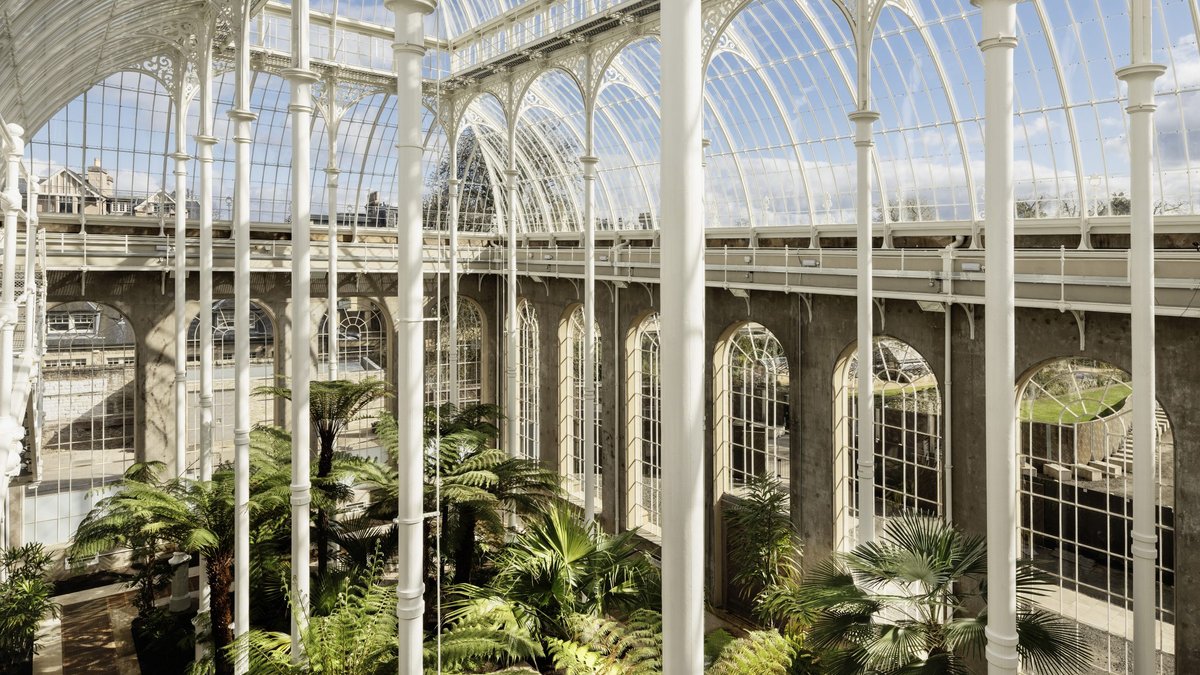
Today historic palm houses of the Royal Botanic Gardens Edinburgh reopen to the public following a five-year restoration project. This marks the completion of a transformative phase of the wider £58 million Edinburgh Biomes restoration and development programme.
Restoration details and plant conservation
The project required the careful relocation of around 800 plant species before construction could begin. Many of the tallest palms and ferns had to be turned horizontally to remove them from the structures. The garden’s research glasshouses then cared for these specimens for five years, after which 600 were selected to return to the Palm Houses. A particular emphasis was placed on palms and ferns.
Unfortunately, not all of the plants survived the process. The tallest palm could not be saved because it was pressing against the glass ceiling. The team knew in advance that it would not be possible to get it out and replant it successfully. Garden scientists identified the plant as Sabal mexicana, a species previously unrecorded in the collection. This discovery came while documenting the massive palm ahead of its removal. The horticulture team saved seeds from the specimen, and one of its progeny has now been planted in the Palm Houses near where its parent once grew.
Replacing the glass presented a significant technical challenge. Each of the 5,750 panes had to be individually measured because they were all slightly different sizes. The new glass is a replica of the originals but is better able to withstand the strong winds associated with climate change. Expert craftspeople restored 600 square metres of iron work and 500 square metres of sandstone. The restoration also joined the tropical Georgian house, built in 1834, with the temperate Victorian House, built in 1858. This created one unified temperate glass house space.
Project scope and leadership
Professor Julia Knights, the 17th Regius Keeper, described the undertaking as one of the most ambitious capital projects in the Garden’s 356-year history. “The reopening of our historic Palm Houses has taken five years of painstaking restoration work,” she said. “Plus many more years of planning and fundraising. This project represents a significant part of our Edinburgh Biomes programme, with further work to come to restore more of our critical infrastructure to protect our precious National Botanical Living Collection of 13,500 plant species.”


