
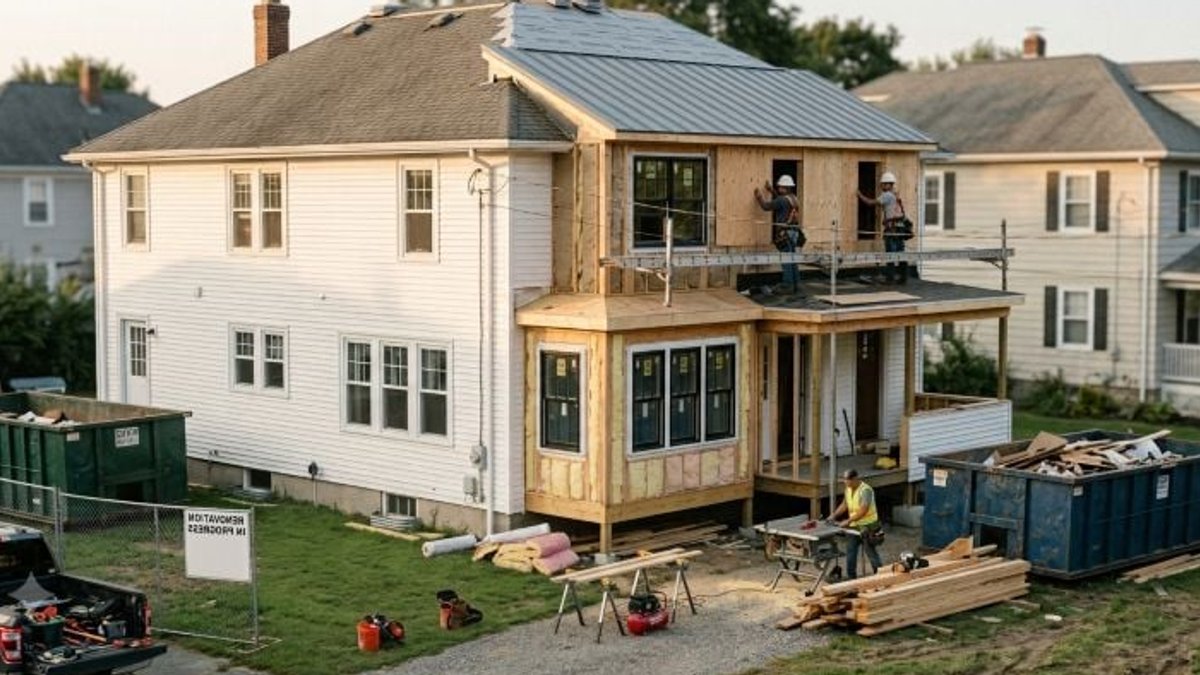
Home renovation budgets frequently overlook key expenses, creating financial shortfalls before projects are completed. By planning for six specific costs upfront, homeowners and investors significantly reduce the risk of running out of funds mid-construction. These often-missed expenses include hazardous material testing, permits and inspections, ongoing property taxes and insurance, material losses from errors and returns, mid-project design changes, and the difference between renovation costs and resale value gains. Addressing these items early ensures a more accurate and sustainable budget for the entire project.
The invisible costs around the work
Most renovation budgets begin with a contractor’s estimate, which covers the planned work. These estimates rarely account for the expenses that sit around the work, such as financing, ownership costs during construction, and the market value of the finished result. Those costs are real, and for investors they can determine whether a project makes financial sense at all.
Older homes can contain materials that require testing before they are disturbed. The EPA’s guidance on asbestos in home building materials notes that it is not possible to tell whether a material contains asbestos simply by looking at it. If a suspect material such as floor tile, ceiling tile, or old pipe wrap is damaged, or if a renovation will disturb it, the EPA recommends having it sampled by a trained and accredited asbestos inspector, who should use a qualified laboratory for the analysis.
Testing is a modest cost. Discovering a problem after demolition has started is not, because work may have to stop while the material is assessed and handled correctly. Investors buying older properties should budget for testing during due diligence, before the purchase price is final.
Materials are one of the largest parts of a renovation budget and one of the least visible. Costs leak through items ordered twice, restocking fees on returns, short deliveries that are billed in full, and price changes between the quote and the purchase. None of these shows up in an estimate, and most appear only when the final invoice arrives. Contractors who use purchasing software for construction can show owners a clear trail from each order to its delivery and invoice, which makes the materials portion of a budget much easier to audit. Investors managing several properties benefit from asking contractors whether that kind of record is available, and from requesting copies of material invoices with each payment application.
Owners can also reduce waste by confirming quantities before orders are placed and agreeing in advance on who keeps leftover materials, since surplus tile, flooring, or trim is often billed to the project.
Related Post: Essex Family Home Merges Scandinavian, Japanese Design Styles
Permits, inspections, and holding costs
Permit fees are usually easy to find. The less visible cost is the code work that a permit can trigger. Replacing a panel, moving a wall, or adding a bathroom may require upgrades to wiring, smoke detection, ventilation, or egress that were not part of the original plan. Ask the contractor which code upgrades are likely, and add an allowance for them before work begins.
Inspection timing is another hidden cost. Work often cannot continue until a required inspection is passed, so scheduling delays at the building department translate directly into holding costs. Every month a property is under renovation, its owner keeps paying for it. That includes mortgage interest, utilities, property taxes, and insurance, and for investors it also includes the rent that is not coming in. Harvard’s Joint Center for Housing Studies, in its State of the Nation’s Housing 2026 report, found that property taxes rose 31 percent between 2019 and 2025, while average monthly insurance premiums jumped 72 percent.
A simple way to budget holding costs is to calculate the monthly carrying cost of the property and multiply it by the expected project length, then add a buffer for delays. Some insurers also require different coverage while a home is vacant or under major construction, which is worth confirming before work starts. Investors financing with short-term loans should include interest reserves and any extension fees in this calculation, since a project that runs long can trigger costs written into the loan terms.
Design changes and the value gap
Changes made during construction cost more than the same changes made on paper. A different tile may require new underlayment, a moved outlet may require a new circuit, and a larger window may require a new header. Each change also adds time, which adds holding costs. Finalizing selections before demolition, and putting every later change in writing with its price, keeps this category under control.
A finish schedule helps here. Listing every selection with its product, quantity, and price before demolition starts gives the owner a single reference point for every later decision, and makes the cost of any change easy to see.
The difference between cost and resale value
Not every dollar spent on a renovation comes back at sale. Zonda’s 2025 Cost vs. Value Report found that eight of the top ten projects ranked by return were exterior replacements. Garage door replacement recouped 267.7 percent of its $4,672 average cost, while a minor kitchen remodel averaging $28,458 recouped 112.9 percent and was the only interior project in the top five. Vinyl siding replacement recouped 96.5 percent of its cost.


