
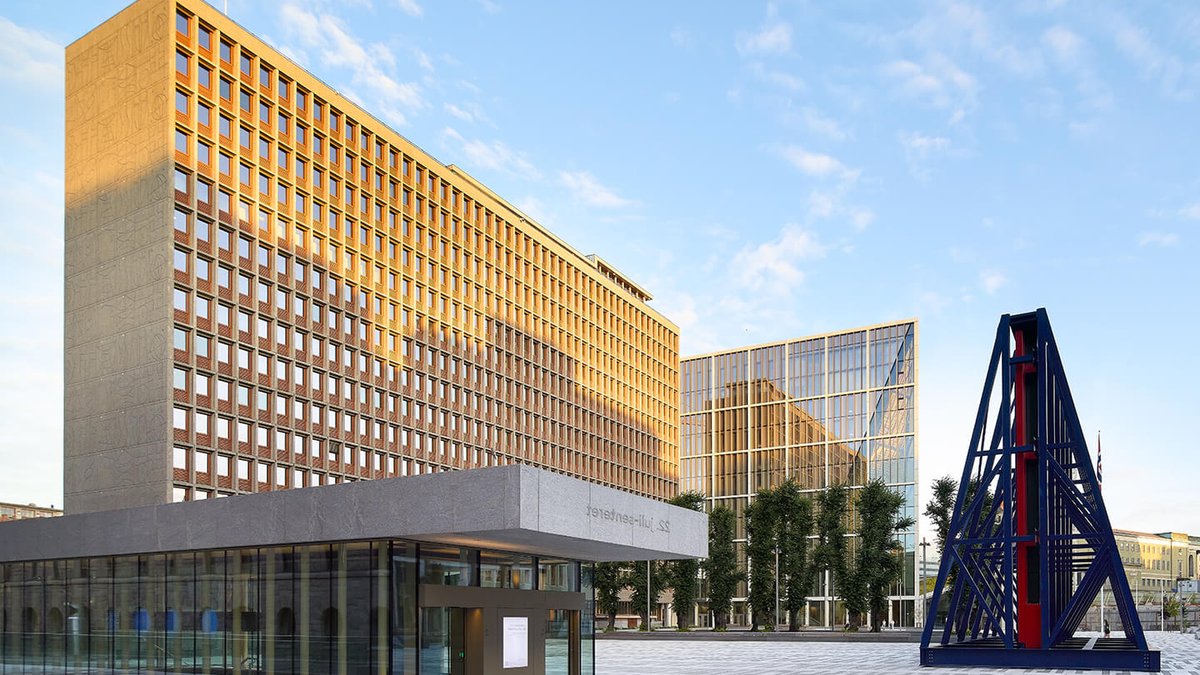
Oslo’s New Government Quarter opens as a civic campus that blends fresh construction with the scars of the July 22, 2011 terror attacks, turning a former blast zone into a space for public life.
Designing a Democratic Campus
The attacks began with a car-bomb in a government parking garage, killing eight people and injuring more than 210. Hours later, a gunman killed 69 teenagers on Utøya island, a summer camp for the Labour Party’s youth wing. Former prime minister Gro Brundtland had visited the island earlier that day.
A consortium called Team Urbis, led by Nordic Office of Architecture and joined by Haptic Architects, Scenario and i-d. Interiørarkitektur & Design, won the competition to rebuild the area. Founder Gudmund Stokke said the task required “a profound respect for the dead and for all the people who have suffered.”
The plan added two new office towers—A-Block and D-Block—and a below-ground museum called the 22 July Centre. Only a modest entrance pavilion rises above the surface, while the rest of the exhibition space remains hidden underground.
Rebuilding After Terror
Two historic plazas, Johan Nygaardsvolds plass and Einar Gerhardsens plass, are now fully pedestrian and free of cars. New bike and foot routes reconnect the Hammersborg neighbourhood, the city centre and the fjord, while security checkpoints remain at the government entrances.
To encourage interaction among the more than 4,000 civil servants who will work there, designers created a “ring of ministries”, a series of raised walkways that will eventually link all buildings.
According to Knut Hovland, Nordic’s Head of Design, “Climate policy intersects with energy, transport and finance, for example. Likewise, digitalization affects security, welfare delivery and regulation.”
For staff who spend most of their days in meetings, the open walkways and shared plazas mean they can step outside without a security badge, sit on a bench, or join a spontaneous protest. The layout invites everyday dialogue, turning a formerly fortified zone into a place where ordinary citizens can gather and be heard.
Related Post: Holcim HQ showcases sustainable building design
Preserving Historic Landmarks
The 1969-era Y-Block, a modernist landmark designed by Erling Viksjø, was demolished because of severe damage. Its iconic sandblasted murals, The Fishermen and The Seagull, created from Pablo Picasso sketches and Carl Nesjar’s adaptations, were rescued and reinstalled on the façade of A-Block.
A-Block’s “Pyramid Hall” rises 51 metres, dwarfing nearby Trinity Church. The atrium houses AAhkA (Mother Earth), a site-specific artwork by Sámi-Finnish artist Outi Pieski that depicts a figure wearing a traditional foremother’s hat and a bejeweled hand clutching a spear.
Inside, timber harvested from Nordmarka forest lines walls and floors, giving the interior a warm texture. A sculptural double-curve staircase, crafted by Risør Båtbyggeri and Biko, lifts visitors as if cradled by giant hands, linking the new tower to the restored H-Block.
Preservation details include a square of sandblasted concrete cut from H-Block’s façade, displayed as a sculpture in a communal room, and pilotis from the original structure encased in metal casings. Timber-framed windows salvaged from the demolished Y-Block replace broken panes on H-Block.
Honoring Victims Memories
The 22 July Centre’s exhibition space reveals the blast’s physical remnants: a shattered clock face, police gear used during the response, and a video where a survivor recounts hearing a friend’s shot and then being shot herself. An invitation to build a cairn sits in a circular groove, encouraging visitors to add a stone.
Art and Memory in Public Spaces
One installation consists of one-hundred-fifty ribbons woven with traditional techniques, placed outside the prime minister’s office.
The ribbons display a mixture of ornamental patterns, Norwegian words, runes, Morse code, and symbols drawn from diverse cultures. The New Government Quarter brings together more than 4,000 civil servants across multiple ministries on a historic city-centre site, and with its unique design, it aims to support cross-disciplinary collaborations and become a symbol of Norway’s enduring democratic values.


